

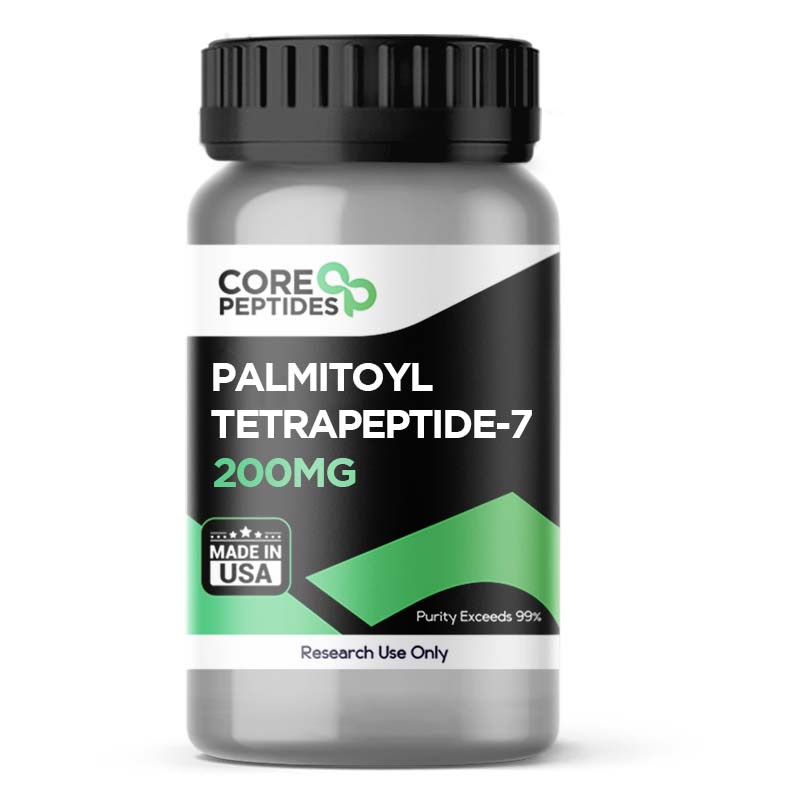
Palmitoil Tetrapeptídeo-7 (200 mg)
$197.00
Tamanho: 200mg
Conteúdo: Palmitoil Tetrapeptídeo-7
Forma: Pó liofilizado
Pureza: >99%
SKU: P-PAL-TETRA-7
Frete GRATUITO para pedidos acima de $ 200
Desconto por quantidade
| Quantidade | 5 - 8 | 9 + |
|---|---|---|
| Desconto | 5% | 10% |
| Preço | $187.15 | $177.30 |
Palmitoil Tetrapeptídeo-7
Palmitoil Tetrapeptídeo-7 é um pequeno peptídeo composto por quatro aminoácidos: palmitoil, glicina, glutamina e arginina.(1) É um peptídeo sintético análogo do peptídeo natural matricina, que é considerado um papel vital na regulação da renovação da matriz extracelular (ECM) e outras atividades celulares relacionadas.
A pesquisa inicial sugere que o peptídeo Palmitoil Tetrapeptídeo-7 pode estimular a síntese de componentes da MEC, como colágeno e elastina, e pode inibir a produção de citocinas pró-inflamatórias. Também foi levantada a hipótese de modular a expressão gênica envolvida na remodelação da MEC, proliferação celular e inflamação.(2)
Além disso, o Palmitoil Tetrapeptídeo-7 pode funcionar suprimindo a atividade da interleucina-6 (IL-6), uma citocina pró-inflamatória que desempenha um papel na apoptose das células da pele (envelhecimento e morte celular) e na inflamação. Considera-se que a secreção de IL-6 aumenta com o tempo, levando à degradação da MEC e resultando na perda de flexibilidade e integridade estrutural da barreira cutânea.
Maquiagem Química(1)
Fórmula molecular: C34H62N8O7
Peso molecular: 694,9g/mol
Outros títulos conhecidos: Pal-Gly-Gln-Pro-Arg-OH, N-Palmitoilrigina, Palmitoil-GQPR, Rigin
Pesquisa e Estudos Clínicos
Mecanismo de ação do palmitoil tetrapeptídeo-7
Com base em estudos em animais, foi sugerido que o Palmitoil Tetrapeptídeo-7 inibe potencialmente a atividade das metaloproteinases de matriz (MMPs) em modelos animais.(3) MMPs are a group of enzymes that may degrade ECM proteins during normal tissue growth. By downregulating MMP activity, Palmitoyl Tetrapeptide-7 may prevent ECM damage and may allow cells to restore and maintain the ECM. More specifically, the peptide might stimulate the production of key components of the skin's extracellular matrix, such as laminin IV and V as well as collagen VII. Laminins may be essential for the structural stability and integrity of the basement membrane, while collagen VII is considered critical in anchoring fibrils that connect the dermis to the epidermis. By potentially enhancing the production of these molecules, Palmitoyl Tetrapeptide-7 might contribute to the maintenance and repair of the skin barrier, thereby improving skin tissue resilience. The peptide is also thought to potentially decrease IL-6 secretion, a cytokine that is believed to play a pivotal role in promoting inflammation. By possibly reducing the levels of IL-6, Palmitoyl Tetrapeptide-7 may act to diminish inflammation, particularly following UVB exposure, which is considered to trigger inflammatory responses in the skin.(4)
Palmitoil Tetrapeptídeo-7 e condições orais
Given the inhibitory potential of the peptide on matrix metalloproteinases (MMPs), research teams have thought to examine the potential action of Palmitoyl Tetrapeptide-7 in mitigating the symptoms of certain oral conditions. MMPs enzymes may break down extracellular matrix (ECM) proteins, including those in the oral cavity. While these enzymes are considered to play a role in various physiological and pathological processes, including tissue repair, wound healing, and inflammation, excessive MMP activity might result in tissue damage and may cause various oral diseases, such as periodontitis, caries, and oral cancer. Studies have also suggested that MMP activity may be upregulated in some oral conditions, including periodontitis, characterized by the destruction of periodontal tissues. The possible inhibition of MMP activity by Palmitoyl Tetrapeptide-7 might potentially prevent or slow the progression of periodontitis (and other oral ailments) by preserving the integrity of the ECM.(3)
Palmitoil Tetrapeptídeo-7 e danos à pele
Estudos sugerem que o peptídeo pode estimular a síntese de colágeno, componente-chave da matriz extracelular da pele, e pode produzir ação antiinflamatória, o que pode reduzir os danos causados por fatores ambientais, como radiação UV e poluição.
A pesquisa sugeriu que a combinação de Palmitoyl Tetrapeptídeo-7 com Palmitoyl Oligopeptídeo (Matrixyl 3000) pode estimular sinergicamente a produção de colágeno e reduzir a inflamação. Esta sinergia, que o estudo descreve como "dramático," pode ajudar a melhorar a textura da pele e reduzir a profundidade e a extensão das rugas que podem ocorrer ao longo do estrato córneo da barreira epidérmica.(5)
De acordo com os estudos, “Matrixyl 3000 é uma combinação sinérgica de dois peptídeos ativos para a pele, Palmitoyl oligopeptídeo e Palmitoyl-tetrapeptídeo-7, que parece promissor com base nos dados preliminares do fabricante... No entanto, ainda não foi comprovado que é eficaz por estudos clínicos independentes publicados.”
Conforme discutido, o Palmitoil Tetrapeptídeo-7 pode ter como alvo particular a estimulação do colágeno tipo VII.(4) Collagen type VII is posited to be a vital component of the skin tissues' architecture, primarily contributing to the stability and structural integrity of the dermal-epidermal junction. It is thought to play a key role in anchoring fibrils that connect the outer epidermis to the deeper dermis. This specific collagen might form a crucial part of the basement membrane, potentially serving as a scaffold that maintains the structural cohesion between these skin layers. The presence and functionality of collagen type VII are considered essential for the prevention of blistering disorders, which occur when there is a breakdown in this connection between the dermis and epidermis. Moreover, collagen type VII may also play a role in skin tissue healing. This type of collagen could be critical in skin recovery and repair by possibly facilitating the reattachment of the epidermis to the underlying tissue after an injury. It is posited that enhancing the synthesis of collagen VII might improve wound healing outcomes, particularly in environments compromised by age or dermal afflictions.
Palmitoil Tetrapeptídeo-7 e profundidade das rugas
O peptídeo, às vezes classificado como um composto “antienvelhecimento”, é assim chamado devido à sua ação potencial percebida e ao aumento da produção de proteínas integrais na pele, conforme discutido acima. Em um estudo clínico randomizado, duplo-cego e controlado por placebo, 20 modelos de pesquisa receberam um creme contendo Palmitoil Tetrapeptídeo-7 por 12 semanas. O creme foi aplicado duas vezes ao dia nas rugas observáveis ao longo da pele.
No final do período de estudo, os investigadores relataram que o creme contendo Palmitoyl Tetrapeptídeo-7 parecia ter reduzido a profundidade e o comprimento das rugas em comparação com o creme placebo.(6) Os pesquisadores também observaram um aumento aparentemente significativo na elasticidade da pele no grupo que recebeu o creme Palmitoyl Tetrapeptídeo-7.
In another study, 20 research models were exposed to the peptide compound twice a day for four weeks, and instrumental measurements were taken to assess the improvement of biomarkers of cell aging and ECM decline. The study reported an apparent reduction in fine wrinkles by 5.97% after two weeks and 14.07% after four weeks, and a reported increase in skin elasticity by 6.81% after two weeks, and 8.79% after four weeks. Dermal density was reportedly increased by 16.74% after two weeks, and 27.63% after four weeks.(7)
Palmitoyl Tetrapeptídeo-7 está disponível apenas para fins de pesquisa e laboratório. Por favor, revise e siga nosso Termos e Condições antes de fazer o pedido.
Referências
- Centro Nacional de Informação sobre Biotecnologia (2023). Resumo do composto PubChem para CID 10078408, Palmitoil tetrapeptídeo-7.
- Mondon P, Hillion M, Peschard O, Andre N, Marchand T, Doridot E, Feuilloley MG, Pionneau C, Chardonnet S. Avaliação da matriz extracelular dérmica e modificações da junção epidérmico-dérmica usando imagens de espectrometria de massa de dessorção/ionização a laser assistida por matriz, microscopia confocal de refletância in vivo, ecografia e histologia: efeito da idade e aplicações de peptídeos. J Cosmet Dermatol. junho de 2015;14(2):152-60. doi: 10.1111/jocd.12135. Epub 2015, 27 de março. PMID: 25817264. https://pubmed.ncbi.nlm.nih.gov/25817264/
- Sorsa T, Tjäderhane L, Salo T. Metaloproteinases de matriz (MMPs) em doenças bucais. Dis Oral. Novembro de 2004;10(6):311-8. doi: 10.1111/j.1601-0825.2004.01038.x. PMID: 15533204. https://pubmed.ncbi.nlm.nih.gov/15533204/
- Resende, Diana ISP et al. “Uso de peptídeos sintéticos em cosméticos para peles sensíveis.” Farmacêutica (Basileia, Suíça) vol. 14,8 702. 21 de julho de 2021, doi:10.3390/ph14080702
- Matrixyl 3000 (oligopeptídeo palmitoil e tetrapeptídeo palmitoil-7): De volta ao futuro dos cuidados com a pele.
- Marta Salvador-Ferreira et al. Tendências de Peptídeos Antienvelhecimento. Jornal MDPI, Vol 7, Edição 4. https://www.mdpi.com/2079-9284/7/4/91
- Hahn Hyung Jin et al. Avaliação instrumental dos efeitos antienvelhecimento de formulações cosméticas contendo peptídeos de palmitoil, óleo de semente de Silybum marianum, vitamina E e outros ingredientes funcionais na pele humana envelhecida, Medicina Experimental e Terapêutica, junho de 2016.