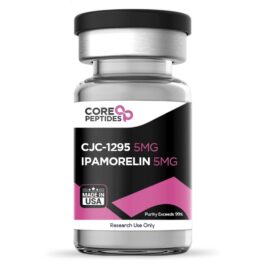
Mistura Mod GRF 1-29 e Ipamorelin (10 mg)
$84.00
Tamanho: 10 mg
Conteúdo: Mod GRF 1-29 (5mg) e Ipamorelin (5mg)
Forma: Pó liofilizado
Pureza: >99%
SKU: P-MODGRFIPAM-10
Frete GRATUITO para pedidos acima de $ 200
Desconto por Quantidade
| Quantidade | 5 - 8 | 9 + |
|---|---|---|
| Desconto | 5% | 10% |
| Preço | $79.80 | $75.60 |
Mod GRF 1-29 e mistura de peptídeos Ipamorelin
O Peptídeo ipamorelina has been studied for its potential as a growth hormone secretagogue (GHS). This synthetic pentapeptide is thought to operate in a manner akin to Growth Hormone Releasing Peptides (GHRPs) and may simulate the natural action of the hunger hormone, ghrelin. Specifically, it is believed that Ipamorelin may activate ghrelin receptors in the anterior pituitary gland, also known as Growth Hormone Secretagogue Receptors 1 Alpha (GHS-R1a). This makes it a notably selective secretagogue and a strong agonist for the growth hormone/ghrelin secretagogue receptor.
What sets Ipamorelin apart is its selectivity, as it does not appear to influence the release of other hormones from the pituitary gland, such as prolactin, follicle-stimulating hormone (FSH), luteinizing hormone (LH), thyroid-stimulating hormone (TSH), or Adrenocorticotropic hormone (ACTH). Modified GRF (1-29) peptide, also known as Mod GRF 1-29, is a synthetic analog of natural growth hormone-releasing hormone (GHRH). Comprising the initial 29 amino acids of the native hormone, this analog appears to stimulate GHRH receptors located in the somatotroph cells of the anterior pituitary gland, thereby facilitating the release of growth hormone. While it shares structural similarities with GRF 1-29, Mod GRF 1-29 has been slightly altered by replacing four amino acids in its original sequence. These adjustments seem to improve the peptide's pharmacokinetic properties. When presented together as a blend, these peptides appear to yield synergistic results, possibly stimulating the pituitary gland and triggering the release of growth hormone.
Maquiagem Química (1)(2)(3)
Fórmula molecular:
- GRF 1-29 modificado:C152H252N44O42
- Ipamorelina: C38H49N9O5
Peso molecular:
- GRF 1-29 modificado: 3367,95g/mol
- Ipamorelina: 711,86g/mol
Outros títulos conhecidos
- GRF 1-29 modificado: Mod GRF 1-29, CJC-1295 sem DAC
- Ipamorelina: Acetato de Ipamorelina, Aib-His-D-2-Nal-D-Phe-Lys-NH2
Pesquisa e Estudos Clínicos
Mod GRF 1-29 e Ipamorelin Blend Pesquisa Geral
Um estudo de 1998(4) was carried out where these growth hormone secretagogues were presented in the rat pituitary gland as well as in anesthetized rats and conscious swine. Results of all three studies suggested that these peptides are agonists of GHRP-like receptors, as they bind to these receptors and help secrete higher concentrations of growth hormone. While some growth hormone secretagogues also appeared to trigger increased levels of other hormones such as cortisol and ACTH, Ipamorelin and Modified GRF 1-29 peptides appeared to exhibit selectivity towards growth hormones only, suggesting that these peptides may be particular in their functions.
Em um estudo clínico de 1999,(5) oito sujeitos de teste foram inscritos para examinar o potencial dos secretagogos do hormônio do crescimento em diferentes concentrações. As concentrações foram aumentadas a cada 15 minutos por até duas horas. Após a conclusão do estudo, a concentração de hormônios de crescimento pareceu ter aumentado significativamente durante o período do estudo.
Mod GRF 1-29 e mistura e potência de Ipamorelin
Neste estudo preliminar,(6) ratos experimentais foram examinados após serem introduzidos a análogos peptídicos de GHRH, tais como o peptídeo GRF 1-29 modificado. Os resultados sugeriram que o peptídeo pode ser consideravelmente mais potente que o GRF 1-29 normal.
Mod GRF 1-29 e mistura de Ipamorelin e a hipófise
When Mod GRF 1-29 interacts with GHRH receptors on the somatotroph cells of the anterior pituitary gland, it is theorized to act as a catalyst for ensuing cellular activities that may contribute to the release of growth hormone. This interaction is thought to set off a chain of intracellular signaling events. One such signaling route that seems to be engaged is the adenylyl cyclase pathway, potentially leading to the transformation of ATP (adenosine triphosphate) into cAMP (cyclic adenosine monophosphate).(7) The subsequent elevation in cAMP levels is speculated to activate protein kinase A (PKA), which in turn may result in the phosphorylation of various proteins. Among these proteins are the voltage-dependent calcium channels located on the cell membrane. The phosphorylation of these channels is conjectured to facilitate the influx of calcium ions into the somatotrophic cells. Elevated levels of intracellular calcium are considered to be a key factor in the subsequent stages that may lead to growth hormone release. It is further theorized that these high calcium concentrations within the cell could prompt the secretory vesicles in the somatotroph cells to release growth hormone into the bloodstream.
It seems that Ipamorelin may also engage with cells in the front part of the pituitary gland by targeting the N-terminal region of GHS-R1a. This region contains specific binding sites that are likely sensitive to particular sequences in the secretagogue. When Ipamorelin encounters this receptor, it may form a temporary bond, facilitated by hydrogen bonds and van der Waals interactions. This transient bonding may induce a conformational change in the receptor, potentially triggering intracellular signaling pathways, predominantly those associated with G-proteins.(8) Specifically, GHS-R1a is thought to collaborate with a specialized subunit of G-proteins known as Gαq/11. Gαq/11 is believed to interact with PLC, which may then cleave a lipid molecule called phosphatidylinositol 4,5-bisphosphate (PIP2) into two secondary messengers: IP3 (Inositol trisphosphate) and DAG (Diacylglycerol). IP3 may bind to specific sites on an organelle known as the endoplasmic reticulum, possibly leading to the release of calcium ions (Ca2+) and activation of proteins that facilitate the secretion of growth hormone from pituitary cells.(9)
Mod GRF 1-29 e mistura de Ipamorelin e o sistema gastrointestinal
In a particular study, scientists explored how Ipamorelin might influence gastric function, specifically focusing on its potential to accelerate gastric emptying. They used a specialized method to measure gastric emptying, which involves tracking the percentage of radioactivity remaining in the stomach 15 minutes after introducing a specific substance via intragastric gavage. The team noted that the surgical procedures performed on the abdomen could have contributed to a slower rate of gastric emptying, especially evident in the control group that received a vehicle substance. Contrastingly, Ipamorelin seemed to significantly hasten the emptying process when compared to the control group. This led the researchers to consider the possibility that Ipamorelin could enhance the speed of gastric emptying. Further investigations were carried out to understand the compound's impact on the contractile behavior of gastric smooth muscles, which were stimulated by acetylcholine and electrical field stimulation. The findings indicated that surgical intervention and manipulation of the intestines might substantially suppress the contractile responses of these muscles to both stimuli. Interestingly, this suppression appeared to be counteracted when both Ipamorelin and ghrelin were introduced together. This raises the speculative notion that Ipamorelin may not only stimulate the contractility of gastric smooth muscles but also potentially negate the inhibitory action induced by certain surgical procedures.(10)
Mod GRF 1-29 e Ipamorelin Blend e Apetite
O impacto potencial do Ipamorelin nos receptores da grelina sugere que pode aumentar o apetite e, talvez, contribuir para o ganho de peso. Um estudo indica que os indivíduos experimentais experimentaram um aumento aproximado de 15% no peso corporal quando expostos ao Ipamorelin.(11) Os pesquisadores teorizam que este composto pode ter aumentado proporcionalmente o peso da camada de gordura em relação à massa corporal total.(11) Como resultado, as medições de absorciometria de raios X de dupla energia (DEXA) podem mostrar um aumento relativo na gordura corporal. Além disso, os dados sugerem que Ipamorelin pode ter aumentado os níveis de leptina sérica, um hormônio implicado na regulação da energia e do apetite. Isto leva os cientistas a levantar a hipótese de que o aumento da ingestão de alimentos pode ser um fator no ganho de peso observado entre os grupos de Ipamorelin. Eles comentaram que “Os GHS aumentam a gordura corporal por mecanismos independentes do GH que podem incluir aumento da alimentação.”
Mod GRF 1-29 e mistura de Ipamorelin e densidade óssea
In a study involving murine models, Ipamorelin and a control substance were introduced to assess their potential on bone mass. Real-time DEXA was employed to monitor changes in bone mineral content, focusing on specific regions like the femur and L6 vertebrae. After the research period, mid-diaphyseal peripheral quantitative computed tomography (pQCT) scans were conducted on the femurs of the subjects. Initial findings indicate that Ipamorelin may be linked to a potential increase in weight as well as a possible uptick in bone mineral content in the tibia and vertebrae, as revealed by DEXA, when compared to the control group. Moreover, pQCT data suggests that the observed rise in cortical BMC may be attributable to an enlargement in the bone's cross-sectional area.(12) Os pesquisadores também postularam que “pequenos efeitos estimuladores no crescimento ósseo linear podem não ter sido detectados estatisticamente nos grupos tratados com GH e ipamorelina,”
Mod GRF 1-29 e Ipamorelin Blend estão disponíveis apenas para fins de pesquisa e laboratório. Por favor, revise e siga nosso Termos e Condições antes de fazer o pedido.
Referências
- Centro Nacional de Informação sobre Biotecnologia (2023). Resumo do composto PubChem para CID 91976842, CJC1295 sem DAC. https://pubchem.ncbi.nlm.nih.gov/compound/CJC1295-Without-DAC.
- Centro Nacional de Informação sobre Biotecnologia (2023). Resumo do composto PubChem para CID 9831659, Ipamorelin. https://pubchem.ncbi.nlm.nih.gov/compound/Ipamorelin.
- Jetté L, Léger R, Thibaudeau K, Benquet C, Robitaille M, Pellerin I, Paradis V, van Wyk P, Pham K, Bridon DP. Os bioconjugados do fator de liberação do hormônio de crescimento humano (hGRF) 1-29-albumina ativam o receptor GRF na hipófise anterior em ratos: identificação de CJC-1295 como um análogo de GRF de longa duração. Endocrinologia. Julho de 2005;146(7):3052-8. doi: 10.1210/en.2004-1286. Epub 2005, 7 de abril. PMID: 15817669. https://pubmed.ncbi.nlm.nih.gov/15817669/
- Raun K, Hansen BS, Johansen NL, Thøgersen H, Madsen K, Ankersen M, Andersen PH. Ipamorelin, o primeiro secretagogo seletivo do hormônio do crescimento. Eur J Endocrinol. Novembro de 1998;139(5):552-61. doi: 10.1530/eje.0.1390552. PMID: 9849822. https://pubmed.ncbi.nlm.nih.gov/9849822/
- Gobburu, JVS, Agersø, H., Jusko, WJ et al. Modelagem Farmacocinético-Farmacodinâmica de Ipamorelin, um Peptídeo Liberador de Hormônio de Crescimento, em Voluntários Humanos. Pharm Res 16, 1412–1416 (1999). https://doi.org/10.1023/A:1018955126402
- Schally AV, Zhang X, Cai R, Hare JM, Granata R, Bartoli M. Ações e aplicações terapêuticas potenciais de agonistas do hormônio liberador do hormônio do crescimento. Endocrinologia. 1º de julho de 2019;160(7):1600-1612. https://pubmed.ncbi.nlm.nih.gov/31070727/
- Sinha, DK, Balasubramanian, A., Tatem, AJ, Rivera-Mirabal, J., Yu, J., Kovac, J., Pastuszak, AW, & Lipshultz, LI (2020). Além do receptor andrógeno: o papel dos secretagogos do hormônio do crescimento no manejo moderno da composição corporal em homens hipogonadais. Andrologia translacional e urologia, 9 (Suppl 2), S149 – S159. https://doi.org/10.21037/tau.2019.11.30
- Yin, Y., Li, Y. e Zhang, W. (2014). O receptor do secretagogo do hormônio do crescimento: sua sinalização e regulação intracelular. Jornal internacional de ciências moleculares, 15(3), 4837–4855. https://doi.org/10.3390/ijms15034837
- Bill, CA e Vines, CM (2020). Fosfolipase C. Avanços em medicina experimental e biologia, 1131, 215–242. https://doi.org/10.1007/978-3-030-12457-1_9
- Greenwood-Van Meerveld, B., Tyler, K., Mohammadi, E. e Pietra, C. (2012). Eficácia da ipamorelina, um mimético da grelina, na dismotilidade gástrica em um modelo de íleo pós-operatório em roedores. Jornal de farmacologia experimental, 4, 149–155. https://doi.org/10.2147/JEP.S35396
- Lall, S., Tung, LY, Ohlsson, C., Jansson, JO e Dickson, SL (2001). Estimulação da adiposidade independente do hormônio do crescimento (GH) pelos secretagogos do GH. Comunicações de pesquisa bioquímica e biofísica, 280(1), 132–138. https://doi.org/10.1006/bbrc.2000.4065
- Svensson, J., Lall, S., Dickson, SL, Bengtsson, BA, Rømer, J., Ahnfelt-Rønne, I., Ohlsson, C., & Jansson, JO (2000). Os secretagogos de GH ipamorelina e o peptídeo-6 liberador de GH aumentam o conteúdo mineral ósseo em ratas adultas. O Jornal de endocrinologia, 165(3), 569–577. https://doi.org/10.1677/joe.0.1650569