

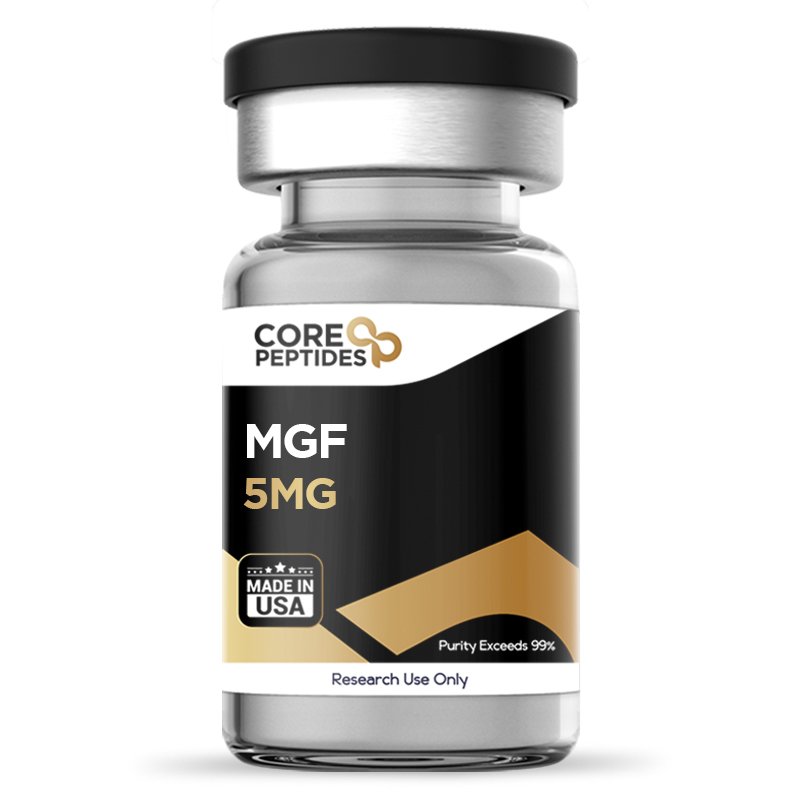
MGF (5mg)
$50.00
Tamanho: 5mg
Conteúdo: MGF (5mg)
Forma: Pó liofilizado
Pureza: >99%
SKU: P-MGF-5
Frete GRATUITO para pedidos acima de $ 200
Desconto por quantidade
| Quantidade | 5 - 8 | 9 + |
|---|---|---|
| Desconto | 5% | 10% |
| Preço | $47.50 | $45.00 |
Peptídeo do fator de crescimento mecânico (MGF)
MGF significa Mechano Growth Factor, um peptídeo endógeno de ocorrência natural que pertence à classe da família IGF-1 (fator de crescimento semelhante à insulina).(1) O que diferencia o MGF do IGF-1 sistêmico é que ele contém 49 pares de bases no éxon 5 em sua composição estrutural, o que pode possivelmente introduzir um frameshift para exercer características únicas.(2) Os pesquisadores consideram o MGF uma isoforma do IGF-1, também conhecido como IGF-1Ec (também conhecido como MGF completo).(3)
À medida que o IGF-1 sofre splicing e transcrição alternativos, parece produzir três isoformas. O IGF-1 sofre emenda sob condições de estresse, como durante atividades de resistência dentro de grupos musculares.(4) Como resultado desta união e devido à inserção única de 49 pares de bases adicionada ao péptido, pode produzir uma isoforma madura de IGF-1, nomeadamente, MGF de ocorrência natural.(4)
Visão geral
Durante os estudos de pesquisa do IGF-1, os cientistas postularam pela primeira vez o fenômeno do splicing do IGF-1 e da produção de isoformas. O único factor identificado pelos investigadores que distinguiu as três isoformas parece ser a sequência de aminoácidos ligada ao terminal COOH. Foi apenas no final da década de 1990 e início de 2000 que a singularidade do IGF-1Ec foi sugerida quando se teorizou que os seus níveis aumentavam com a lesão muscular.(5)
Existe uma versão sintética do peptídeo MGF composto por 24 aminoácidos ligados ao terminal C do domínio isolado do MGF, denominado peptídeo MGF-Ct24E, ou domínio E do IGF-1Ec.(6) Durante os estudos realizados no início dos anos 2000,(6) foi sugerido que o peptídeo MGF-Ct24E pode exibir potencial para induzir a proliferação de células precursoras musculares. As células precursoras musculares são células “satélites” na miofibra, que aumentam para formar novos músculos.
MGF is posited to increase in a growth hormone-dependent fashion, akin to IGF-1, which is also considered to potentially represent the main anabolic mediator of growth hormone. Studies suggest that growth hormones may also impact MGF expression by approximately 80%, relative to the baseline. In stark contrast, resistance activity in muscle tissue alone appears to elicit a response in MGF mRNA, with an increase of 163% from baseline. This immediate response may suggest a more direct or sensitive reaction of MGF to mechanical stimuli, yet the extent and nature of this sensitivity remain speculative. An apparent elevation of growth hormone that occurs in addition to resistance training might further complicate this response, as supported by a reported 456% increase in MGF mRNA.(7)
Estudos de pesquisa ainda estão em andamento para determinar o mecanismo de ação do peptídeo MGF de ocorrência natural e desenvolvido sinteticamente. As hipóteses sob investigação incluem o impacto potencial do peptídeo nas células musculares danificadas, reparo e recuperação de tecidos, possíveis características neuroprotetoras e cardioprotetoras e impacto potencial na apoptose das células musculares.
Maquiagem Química
Fórmula molecular: C124H204N42O41S1
Peso molecular: 2.971,99g/mol
Outros títulos conhecidos: MGF-E, MGF-Ct24E
Pesquisa e Estudos Clínicos
Peptídeo MGF e massa muscular
O principal objetivo de um estudo crítico sobre o MGF(8) was to determine the potential of the synthetic peptide, aka the MGF-E domain made of 24 amino acids, on different aged cells. This was a study where muscle cell cultures, which ranged from neonatal to aged, were evaluated. The culture cells were analyzed after exposure to MGF-E. The peptide seemed to delay the onset of cellular senescence in younger cells, suggesting a potential to preserve muscle function and repair capabilities that diminish naturally. Furthermore, the results suggested cell proliferation in all cells isolated from neonatal to young cells; however, this was not the case in aged cells. Muscle hypertrophy appeared to be increased in the older cells, with a significant decrease in the reserve cells. It appeared to have induced hypertrophy in muscle cells across all ages by increasing the fusion index and the size of myotubes, which are formed from the fusion of muscle cells. The researchers observed that MGF-E may potentially also increase the expression of muscle-specific contractile proteins, indicating not only an increase in muscle cell size but also in functional capacity. Furthermore, the reduction in reserve cells appears notable as this may be a subpopulation of cells that do not initially differentiate or fuse into myotubes. MGF-E apparently led to a decreased proportion of these reserve cells in culture, suggesting that the peptide might prompt these cells to contribute to muscle formation. This finding is particularly noteworthy as it points to a mechanism by which MGF might potentially enhance muscle regeneration and maintenance.
Peptídeo MGF e recuperação muscular
O objetivo principal de outro estudo(9) was to evaluate the potential of MGF on skeletal muscle injury repair and healing. This study was performed on mice that were experimentally induced with muscle contusion. Following Mechano Growth Factor (MGF) exposure and analysis of the muscle tissues, researchers suggested that MGF may have reduced the expressions of inflammatory markers such as cytokines and chemokines. Further, there was an apparent reduction of oxidative stress markers and matrix metalloproteinases (MMPs), suggesting that MGF might mitigate some inflammatory and fibrotic responses in muscle injury. As a result, the rate of contused muscles appeared to decline, which might induce long-term muscular repair of the wounded tissues. Moreover, the study hints that MGF may potentially not markedly impact the functional state of satellite cells following injury and immune cell depletion at the injury site, which is integral to muscle regeneration. This inference is drawn from observing unaltered expression levels of MyoD and myogenin—key satellite cell proliferation and differentiation indicators, respectively. This suggests that while MGF might potentially ease certain aspects of the muscle injury response, its direct action on satellite cell activity under the explored conditions remains uncertain. Subsequent examinations suggest that MGF exposure might influence fibrosis in injured muscle by possibly reducing the expression of collagen types I and III, crucial for the extracellular matrix and fibrotic development. The study further hints that MGF may play a part in adjusting the inflammatory setting within injured muscles. This is somewhat illustrated by a purported reduction in the expression of pro-inflammatory cytokines (TNF-α, IFN-γ, IL-1β, TGF-β) and chemokines (CCL2, CCL5, CXCR4) post-MGF exposure. Moreover, there's a speculative suggestion that MGF might assist in alleviating oxidative stress in injured muscle, indicated by a possible decrease in the expression of gp91phox, a vital component of NADPH oxidase implicated in the production of reactive oxygen species.
Peptídeo MGF e potencial antiapoptótico
O objetivo principal deste estudo(10) was to evaluate the potential of MGF on cardiac muscles undergoing programmed cell death (apoptosis) following hypoxia, a condition characterized by limited supply of oxygen. The study reported that the peptide appeared to induce increased migration of stem cells to the heart tissues exposed to hypoxia, which possibly led to inhibition of apoptosis. This suggests that MGF may play a dual role in cardiac function, acting as a potential anti-apoptotic compound and a stem cell-homing factor. The researchers highlight that MGF potentially enhances the migration of mesenchymal stem cells (hMSCs), indicating a chemotactic action that might be leveraged to direct stem cells toward regions of damage or injury. Moreover, in an environment simulating hypoxic stress—a condition akin to that experienced by heart tissue during ischemic events—MGF is suggested to exhibit protective potential in cardiac cells. This hypothesis was raised by observation of increases in the expression of Bcl-2, a gene associated with cell survival, underscoring MGF's potential anti-apoptotic action.
Peptídeo MGF e lesão esquelética
O objetivo principal deste estudo(11) was to evaluate the potential of MGF on bone injury. A total of 27 rabbits were experimentally induced with a 5-mm bone defect and were then divided into three groups that were presented with MGF or with a control substance for 5 consecutive days. Post-study, the researchers reported that the placebo tissue appeared to be the least healed when the bone tissues were histologically examined. In contrast, the bone tissue with MGF appeared to be the most healed tissue. Regarding the potential impact on osteoblast-like cell proliferation, the investigation hints that MGF might potentially enhance proliferation. This enhancement appears to be more pronounced when compared with IGF-1, leading to the speculation that MGF may activate cellular mechanisms somewhat differently from IGF-1. The study points out that MGF might play a role in arresting the cell cycle in certain phases and could be involved in activating the MAPK-Erk1/2 signaling pathway. Such actions imply that MGF may have a complex approach to promoting cell proliferation, perhaps through a blend of influencing cell cycle dynamics and engaging specific signaling pathways. Moreover, the study ventured into assessing the possible actions of MGF utilizing a rabbit model with established bone defects. Here, MGF was introduced, and its influence on bone healing was monitored via radiographic and histological evaluations. The findings tentatively indicate that bone healing might be improved in defects exposed to MGF, as suggested by seemingly better rates of radiographically healed defects and improved histological scores for bone healing.
Peptídeo MGF e isquemia cerebral
O objetivo principal de um estudo de 2005(12) was to combat ischemic stroke through the potential action of MGF peptides. The actions were studied in experiments conducted on gerbil research models of brain ischemia. The synthetic Mechano Growth Factor peptide was presented as an ischemic mitigator. Researchers reported that MGF appeared to lead to increased protection of brain cells. Interestingly, in the same model, it was also reported that ischemia appeared to lead to elevated endogenous MGF production in the ischemia-resistant neurons. Additional studies were carried out in degenerated hippocampal cell culture, to which MGF was added. MGF exhibited reportedly similar results of muscle proliferation. This potential action is believed to be due to the C-terminal of the MGF peptide, which may exert some level of neuroprotective action.
Peptídeo MGF e células cerebrais
Um estudo notável (13) was conducted on a murine model to study the action of increased MGF concentration on brain cells. One study included breeding mice to constitutively overproduce MGF in the hippocampus area of the brain. The hippocampus is primarily responsible for regulating the neurogenesis phenomenon in the organism. This overproduction of MGF appeared to result in high concentrations of BrdU, a biological marker representative of proliferative actions in the organism. More specifically, the mice were bred for conditional MGF production at 1, 3, and 12 months old. Behavioral analysis and biological responses were examined after 2 years. These mice were reported to exhibit elevated levels of BrdU and neurogenesis.
O peptídeo MGF está disponível apenas para fins de pesquisa e laboratório. Por favor, revise e siga nosso Termos e Condições antes de fazer o pedido.
Referências:
- Philippou A, Papageorgiou E, Bogdanis G, Halapas A, Sourla A, Maridaki M, Pissimissis N, Koutsilieris M. Expressão de isoformas de IGF-1 após dano muscular induzido por exercício em humanos: caracterização das ações do peptídeo MGF E in vitro. In Vivo. 2009 julho-agosto;23(4):567-75. https://pubmed.ncbi.nlm.nih.gov/19567392/
- Goldspink G. Comprometimento do splicing do gene IGF-I e expressão de MGF associada à perda muscular. Int J Biochem Cell Biol. Março de 2006;38(3):481-9. https://pubmed.ncbi.nlm.nih.gov/16463438/
- Zabłocka, B., Goldspink, PH, Goldspink, G., & Górecki, DC (2012). Fator de Crescimento Mecânico: uma engrenagem importante ou um parafuso solto no maquinário de reparo? Fronteiras em endocrinologia, 3, 131. https://www.ncbi.nlm.nih.gov/pmc/articles/PMC3485521/
- G. Goldspink. Pesquisa sobre fator de crescimento mecânico: seu potencial para otimizar o treinamento físico, bem como seu uso indevido no doping. Departamento de Cirurgia, Royal Free e University College Medical School, Hampstead Campus, Rowland Hill Street, Londres NW3 2PF. https://bjsm.bmj.com/content/39/11/787
- Rotwein P. (2014). Editorial: a queda do fator de mecanocrescimento?. Endocrinologia molecular (Baltimore, Maryland), 28(2), 155–156. https://www.ncbi.nlm.nih.gov/pmc/articles/PMC3896639/
- Mills P, Dominique JC, Lafrenière JF, Bouchentouf M, Tremblay JP. Um peptídeo E do fator de crescimento mecânico sintético aumenta o sucesso do transplante de células precursoras miogênicas. Sou J Transplante. Outubro de 2007;7(10):2247-59. https://pubmed.ncbi.nlm.nih.gov/17845560/
- Hameed M, Lange KH, Andersen JL, Schjerling P, Kjaer M, Harridge SD, Goldspink G. O efeito do hormônio de crescimento humano recombinante e do treinamento de resistência na expressão de mRNA de IGF-I nos músculos de homens idosos. J Fisiol. 15 de fevereiro de 2004;555(Pt 1):231-40. doi: 10.1113/jfisiol.2003.051722. Epub 2003, 17 de outubro. PMID: 14565994; IDPM: PMC1664832.
- Kandalla PK, Goldspink G, Butler-Browne G, Mouly V. O peptídeo Mechano Growth Factor E (MGF-E), derivado de uma isoforma de IGF-1, ativa células progenitoras musculares humanas e induz um aumento em seu potencial de fusão em diferentes idades. Desenvolvedor de Envelhecimento Mech. 2011 abril. https://pubmed.ncbi.nlm.nih.gov/21354439/
- Liu X, Zeng Z, Zhao L, Chen P, Xiao W. A regeneração muscular esquelética prejudicada induzida pela depleção de macrófagos pode ser parcialmente melhorada pela injeção de MGF. Fisiol Frontal. 17 de maio de 2019;10:601. https://pubmed.ncbi.nlm.nih.gov/31164836/
- Doroudian, G., Pinney, J., Ayala, P., Los, T., Desai, TA, & Russell, B. (2014). A entrega sustentada do peptídeo MGF a partir de microbastões atrai células-tronco e reduz a apoptose dos miócitos. Microdispositivos biomédicos, 16(5), 705–715. https://doi.org/10.1007/s10544-014-9875-z
- Deng M, Zhang B, Wang K, Liu F, Xiao H, Zhao J, Liu P, Li Y, Lin F, Wang Y. O peptídeo E do fator de crescimento mecânico promove a proliferação de osteoblastos e a cicatrização de defeitos ósseos em coelhos. Int Ortop. Julho de 2011;35(7):1099-106. https://pubmed.ncbi.nlm.nih.gov/21057789/
- Dluzniewska J, Sarnowska A, Beresewicz M, Johnson I, Srai SK, Ramesh B, Goldspink G, Górecki DC, Zabłocka B. Um forte efeito neuroprotetor do peptídeo C-terminal autônomo de IGF-1 Ec (MGF) na isquemia cerebral. FASEB J. novembro de 2005;19(13):1896-8. https://pubmed.ncbi.nlm.nih.gov/16144956/
- Tang JJ, Podratz JL, Lange M, Scrable HJ, Jang MH, Windebank AJ. O fator de crescimento mecânico, uma variante de splicing do IGF-1, promove a neurogênese no envelhecimento do cérebro de camundongos. Mol Cérebro. 7 de julho de 2017;10(1):23. doi: 10.1186/s13041-017-0304-0. PMID: 28683812; IDPM: PMC5501366.