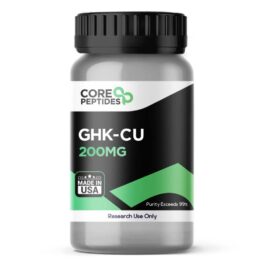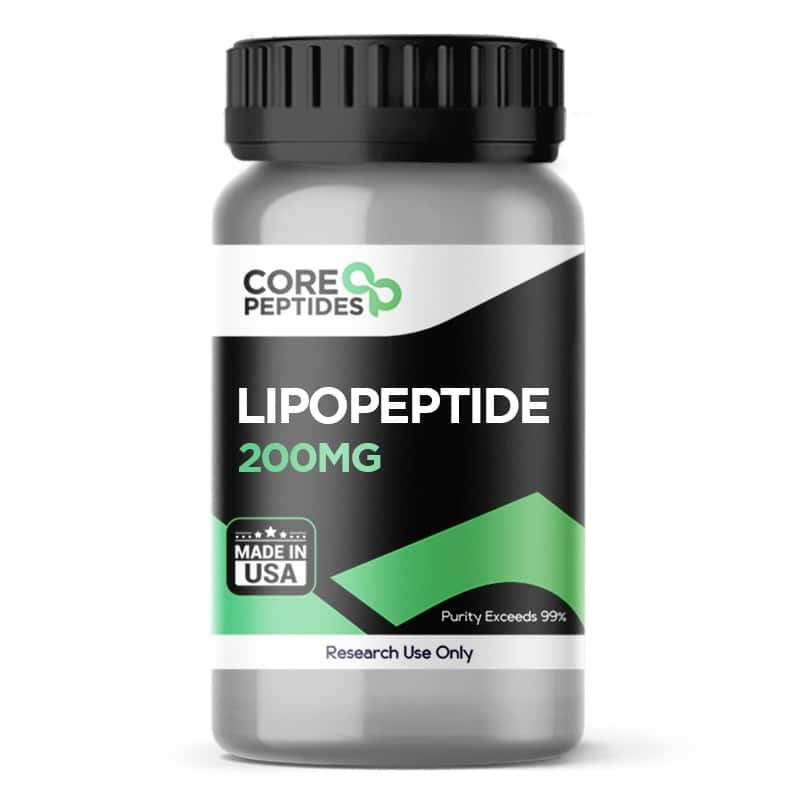
Lipopeptídeos (200mg)
$214.00
Tamanho: 200mg
Conteúdo: GHK-Cu
Forma: Pó liofilizado
Pureza: >99%
SKU: P-LIPOPEPTÍDEO-200
Frete GRATUITO para pedidos acima de $ 200
Desconto por Quantidade
| Quantidade | 5 - 8 | 9 + |
|---|---|---|
| Desconto | 5% | 10% |
| Preço | $203.30 | $192.60 |
Peptídeo Lipopeptídeo
Lipopeptide, characterized by the sequence Palmitoyl-Gly-Gln-Pro-Arg, is a palmitoylated fragment derived from immunoglobulin G (IgG). IgG is a type of antibody, considered a crucial component of the immune system that apparently mediates various inflammatory processes. The palmitoylation of this peptide fragment, which involves the attachment of a palmitic acid molecule, may also enhance its experimental potential. This modification appears to improve the lipopeptide's ability to penetrate through the corneal layers of skin tissue models. The increased penetration appears to be due to the added lipid (fat) component, which aids in traversing the lipid-rich environment of the outer layers of skin tissue.
Maquiagem Química
Fórmula molecular: C38H68N6O8
Peso molecular: 736,9g/mol
Sequência: Pal-Gly-Gln-Pro-Arg
Outros títulos conhecidos: Pal-GQPR, Palmitoil Tetrapeptídeo-7/3
Pesquisa e Estudos Clínicos
O resumo abaixo reflete as últimas descobertas de estudos preliminares sobre as funcionalidades do Lipopeptídeo, reveladas através de diversos métodos experimentais.
Lipopeptídeo e a Matriz Dérmica Extracelular
Um estudo conduziu uma série de avaliações em uma mistura de peptídeos, incluindo Lipopeptídeo (Pal-GQPR), quanto à sua ação potencial na estrutura das células da pele.(1) Echography tests suggested that this blend might reduce the thickness of the subepidermal low-echogenic band and support its density, indicating a possible improvement in skin structure. Moreover, studies in murine models hinted that these peptides might potentially enhance the extracellular dermal matrix structure compared to a placebo. More specifically it was posited that this compound might also play a role in decreasing the secretion of interleukin-6 (IL-6), a cytokine involved in inflammatory responses. IL-6 is a molecule that is typically associated with immune responses and appears to be elevated during inflammation, potentially contributing to various inflammatory skin conditions. The possible reduction of IL-6 secretion by Lipopeptide suggests that it may aid in mitigating inflammation, especially following UVB radiation exposure, a common cause of skin cell inflammation and damage. Additionally, Lipopeptide is thought to potentially stimulate the production of critical structural components around skin cells, such as laminin IV and V, as well as collagen VII. Laminins, particularly types IV and V, are integral components of the basement membrane, a layer that supports epithelial cells and is considered essential for tissue integrity. They play a crucial role in cell adhesion, differentiation, and migration, which are vital for skin repair and maintenance. Collagen VII, on the other hand, is a key component of anchoring fibrils that provide structural support and stability to the skin. It is essential for the attachment of the epidermis to the underlying dermis. The stimulation of these components by Lipopeptide may imply a potential role in enhancing the skin's structural framework.(2) Outros pesquisadores também comentaram que o Lipopeptídeo pode ter uma ação “como agente antiinflamatório e tem efeito antienvelhecimento e reafirmante da pele [potencial].”(3)
Lipopeptídeos e células da pele fotoenvelhecidas
The potential of Lipopeptide was investigated in a randomized controlled trial (RCT) as a blend alongside other peptides and active ingredients. This peptide, along with other compounds, such as retinyl palmitate and natural extracts, was assessed for its potential in improving the appearance of photoaged skin cells. Twelve days into the experiment, the peptide was observed to have stimulated the deposition of fibrillin-1 in the skin, a marker for skin repair, compared to the baseline levels. This was comparable to the apparent results observed with all-trans retinoic acid (RA), considered to be a clinical standard for photoaged skin cells. The accumulation of fibrillin-1 indicates a potential structural change in the skin, although this alone does not confirm the success of the experiment. In a 6-month RCT the peptide appeared to potentiate an improvement in skin wrinkles compared to the baseline. Interestingly, this potential improvement became more pronounced after 12 months. The vehicle formulation, which lacked the active ingredients, did not show similar results, suggesting that the ingredients in the test product, including Lipopeptide, may contribute to the observed effects. Furthermore, the study investigated the distribution of fibrillin-1 in skin biopsies from the RCT. Skin applied with the Lipopeptide appeared to have a significant increase in fibrillin-1 in the papillary dermis compared to the placebo group. This supports the idea that long-term experiments with Lipopeptide may lead to a visible improvement in the photoaged skin. The researchers concluded that Lipopeptide may “produz melhora significativa na aparência das rugas e apoia ainda mais o [estudo] da fibrilina-1 como um biomarcador robusto para o reparo da derme fotoenvelhecida.”(4)
O lipopeptídeo está disponível apenas para fins de pesquisa e laboratório. Por favor, revise e siga nosso Termos e Condições antes de fazer o pedido.
Referências:
- Mondon, P., Hillion, M., Peschard, O., Andre, N., Marchand, T., Doridot, E., Feuilloley, MG, Pionneau, C., & Chardonnet, S. (2015). Avaliação de modificações na matriz extracelular dérmica e na junção epidérmico-dérmica usando imagens de espectrometria de massa de dessorção/ionização a laser assistida por matriz, microscopia confocal de refletância in vivo, ecografia e histologia: efeito da idade e aplicações de peptídeos. Revista de dermatologia cosmética, 14(2), 152–160. https://doi.org/10.1111/jocd.12135
- Resende, D. I. S. P., Ferreira, M. S., Sousa-Lobo, J. M., Sousa, E., & Almeida, I. F. (2021). Uso de Peptídeos Sintéticos em Cosméticos para Pele Sensível. Farmacêutica (Basileia, Suíça), 14(8), 702. https://doi.org/10.3390/ph14080702
- Fadilah, NIM, Rahman, MBA, Yusof, LM, Mustapha, NM e Ahmad, H. (2021). O efeito terapêutico e avaliação in vivo do palmitoil-GDPH no processo de cicatrização de feridas. Farmacêutica, 13(2), 193. https://doi.org/10.3390/pharmaceutics13020193
- Watson, RE, Ogden, S., Cotterell, LF, Bowden, JJ, Bastrilles, JY, Long, SP, & Griffiths, CE (2009). Os efeitos de um produto cosmético 'antienvelhecimento' melhoram a pele fotoenvelhecida [corrigido]. O jornal britânico de dermatologia, 161(2), 419–426. https://doi.org/10.1111/j.1365-2133.2009.09216.x