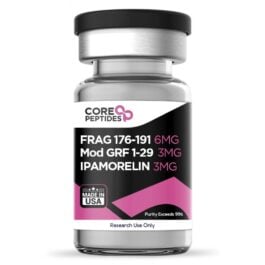


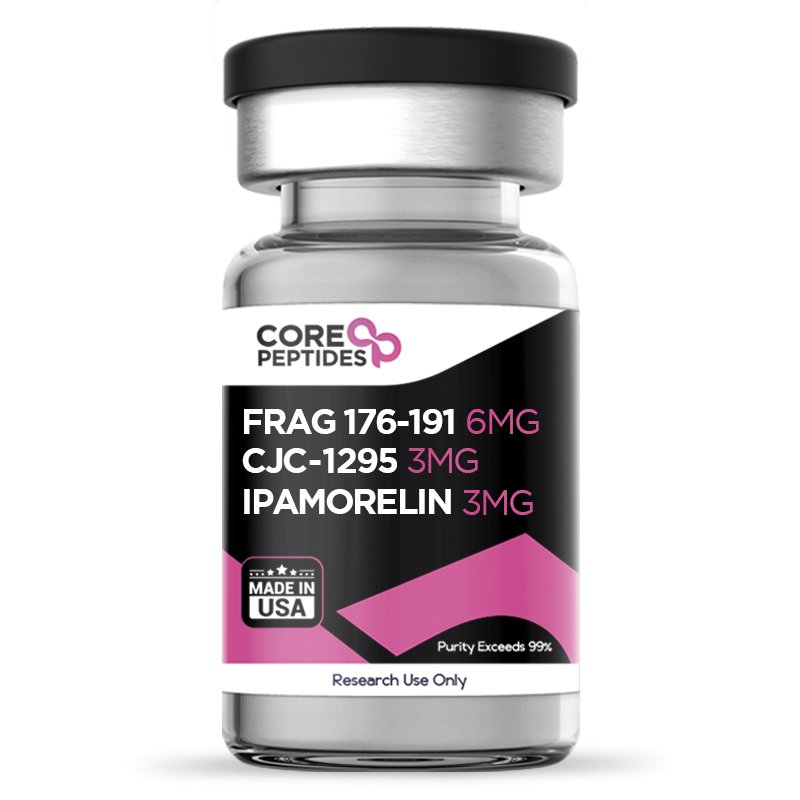
Fragmento 176-191 e CJC-1295 e mistura de Ipamorelin (12 mg)
$73.00
Tamanho: 12mg
Conteúdo: Fragmento 176-191 (6 mg), CJC-1295 NO DAC (3 mg), Ipamorelin (3 mg)
Forma: Pó liofilizado
Pureza: >99%
SKU: P-FRAGCJCIPAM-12
Frete GRATUITO para pedidos acima de $ 200
Desconto por quantidade
| Quantidade | 5 - 8 | 9 + |
|---|---|---|
| Desconto | 5% | 10% |
| Preço | $69.35 | $65.70 |
Fragmento 176-191 e CJC-1295 e mistura de peptídeos Ipamorelin
Os pesquisadores sugeriram que os peptídeos liberadores do hormônio do crescimento (GHRPs), os secretagogos do hormônio do crescimento (GSHs) e os análogos dos hormônios do crescimento (hGH) podem apresentar potencial para promover a secreção do hormônio do crescimento. Quando combinados, os pesquisadores sugeriram que eles exercem uma ação significativa. Estes incluem aumento do metabolismo da gordura, aumento da massa magra, ciclo de sono regulado e melhor funcionamento intestinal e cardíaco.
CJC-1295 is a synthetic peptide composed of 29 amino acids. The peptide appears to work by activating the Growth Hormone-Releasing Hormone (GHRH) receptors in the pituitary gland. These receptors are typically activated by the native GHRH. CJC-1295 appears to be a synthetic analog made of the first 29 amino acids from the GHRH sequence, which has additional modifications, including the replacement of four amino acids in its structure and the attachment of a Drug Affinity Complex (DAC) to potentially extend the pharmacokinetics of the peptide.
Ipamorelina is a synthetic pentapeptide and has been categorized by scientists as a growth hormone secretagogue (GHS). It has been posited to function similarly to Growth Hormone Releasing Peptides (GHRPs) and to potentially emulate the natural hunger hormone, ghrelin, particularly its potential to stimulate the release of hGH from the cells in the anterior pituitary gland. More specifically, Ipamorelin may mimic the function of ghrelin by activating the ghrelin receptors there, which are also known as the Growth Hormone Secretagogue receptors 1 Alpha (GHS-R1a)
Fragmento 176-191 peptídeo, como o nome sugere, é um pequeno “fragmento” do hormônio do crescimento hGH composto por 15 aminoácidos. Este peptídeo pode ter como alvo os receptores adrenérgicos beta-3 (ADRB3), que podem potencialmente induzir perda de peso a jusante. Através destes receptores, sugere-se que o peptídeo pode aumentar a queima de gordura nas células do tecido adiposo e possivelmente promover a “termogênese” nas células do músculo esquelético.
Apresentadas em conjunto, esta mistura pode desencadear uma pequena porção da glândula pituitária, possivelmente estimulando a liberação de hormônios de crescimento. Esta mistura foi postulada por cientistas para aumentar e regular de forma potencialmente sinérgica a concentração do hormônio do crescimento e manter os níveis de equilíbrio.
Maquiagem Química(1)(2)(3)
Fórmula molecular
- Fragmento 176-191:C78H125N23O23S2
- CJC-1295 (Mod GRF 1-29):C152H252N44O42
- Ipamorelina:C38H49N9O5
Peso molecular
- Fragmento 176-191: 1817,12g/mol
- CJC-1295 (Mod GRF 1-29): 3367,9g/mol
- Ipamorelina: 711,8g/mol
Outros títulos conhecidos
- Fragmento 176-191: AOD 9604, fragmento lipolítico de GH (hGH), Somatostatina (177-191), tirosil
- CJC-1295: Mod GRF 1-29, CJC-1295 sem DAC
- Ipamorelina Acetato de Ipamorelina, IPA
Pesquisa e Estudos Clínicos
Fragmento 176-191 e CJC-1295 e mistura de Ipamorelin e hormônios de crescimento
Embora o fragmento 176-191 pareça imitar diretamente a função do hGH, os peptídeos CJC-1295 e Ipamorelin parecem exercer potencial regulando positivamente a síntese do próprio hGH. Por exemplo, foi sugerido que CJC-1295 tem um potencial significativo de aumento de hGH em vários ensaios clínicos de fase 1.
No primeiro, foram inscritos sujeitos de teste com idades entre 20 e 40 anos.(4) All subjects were divided into two groups – one was presented with a saline placebo and the rest with the CJC-1295 peptide. A blood sample was collected from all subjects before and after the peptide presentation. After completion of the study, it was reported by the researchers that the peptide group appeared to exhibit a 7.5-fold increase in their growth hormone levels compared to the standard group. The trend suggested that these hormones increased gradually throughout the study and remained unchanged for at least 7 days after discontinuing presentation.
Outro estudo(5) was conducted on male test subjects aged between 20 and 60. Similar to the previous study, these subjects were divided into two groups – one was presented with a placebo while the rest were given the CJC-1295 peptide. The peptide group was given gradually increasing concentrations of the compound during the study. Upon analyzing the blood samples collected from these subjects, it was observed that there appeared to be a concentration-dependent increase, of up to 10 times, in the concentration of growth hormones among the peptide subjects. As per Madalina Ionescu et al., "O aumento acentuado dos níveis mínimos de GH pela estimulação contínua de GHRH implica a importância deste efeito no aumento do IGF-I. As preparações de GHRH de ação prolongada podem beneficiar pacientes com capacidade secretora de GH hipofisária intacta." (4)
Da mesma forma, também foi sugerido que Ipamorelin aumenta potencialmente a síntese de hGH. Num estudo clínico foi postulado que uma única apresentação do peptídeo pode aumentar os níveis de hGH em mais de 60 vezes em comparação com o placebo.(6)
Fragmento 176-191 & CJC-1295 & Mistura Ipamorelin e Ação Lipolítica
Um ensaio clínico(7) was conducted in 2004 to study the peptide’s potential lipolytic (fat-burning) action. In the trial, 300 subjects were enrolled and presented with the Fragment 176-191 peptide for 12 weeks. These subjects were divided into 6 groups – one given a saline placebo, and the rest presented with different peptide concentrations. The group presented with minimal peptide presence appeared to exhibit a notable reduction in their body weight (up to 2.8 kilograms). These peptides may have also helped improve these subjects’ cholesterol profiles and glucose tolerance levels. The research team stated, “A evidência do ensaio é que durante 12 semanas, [o peptídeo] induz uma perda de peso competitiva com benefícios de saúde que os acompanham…”
Fragmento 176-191 e CJC-1295 e mistura de Ipamorelin e regeneração
Trinta e dois coelhos experimentais foram examinados como parte deste estudo de 2015,(8) all of whom were divided into four groups of eight. All four groups were presented with placebo, Fragment 176-191 peptide, hyaluronic acid, or a combination of the peptide and hyaluronic acid for about 7 weeks. After the completion of the study, all rabbits were checked for any signs of cartilage damage. Among all groups, the rabbits presented with peptide and hyaluronic acid combination appeared to show minimal cartilage degeneration. These results suggest that the peptide may have the capability to enhance cartilage regeneration and repair. The report concluded that “O AOD9604 intra-articular usando orientação por ultrassom melhorou a regeneração da cartilagem, e o AOD9604 e o HA combinados foram mais eficazes do que o HA ou o AOD9604 sozinho no modelo de coelho com OA de joelho induzido por colagenase.” (8)
Fragmento 176-191 e CJC-1295 e mistura de Ipamorelin e composição corporal
As mentioned, Fragment 176-191 may potentiate a favorable shift in body composition by reducing adiposity. Yet, CJC-1295 & Ipamorelin also appear to have a significant potential via different impacts, which may include increasing lean mass for CJC-1295, and increasing overall body weight in the case of Ipamorelin. Research in the lab suggests that Ipamorelin might potentially play a role in weight gain including muscle mass gain but also adiposity, possibly due to both an elevation in hGH levels and its potential to stimulate appetite through ghrelin receptor activation. An investigation into Ipamorelin's potential impact on body fat was conducted in both hGH-deficient and hGH-intact murine models. The results indicated that Ipamorelin may have led to a modest 15% rise in body weight within a span of 2 weeks. Additionally, in both murine models, there was a relative increase in fat pad weights when compared to overall body weight.(9)
On the other hand, CJC-1295 may potentially improve body composition while apparently increasing muscle mass without affecting or even possibly decreasing adiposity. Research involving murine models with a GHRH gene deletion (known as GHRHKO) noted that CJC-1295 might upregulate the synthesis of GH and potentially induce such a favorable shift in body composition. When these GHRHKO murine models were exposed to CJC-1295, they seemed to maintain standard lean mass, compared to unexposed models which failed to achieve normal lean mass. Moreover, the subcutaneous fat mass remained at control levels across all peptide-associated groups, while the GHRHKO murine models not exposed to CJC-1295 appeared to have increased adiposity.(10) Considerando a potencial ação lipolítica do Fragmento 176-191 e CJC-1295, os pesquisadores podem querer considerar a hipótese de que a mistura desses peptídeos pode neutralizar o potencial de aumento de gordura do Ipamorelin, ao mesmo tempo que aumenta ainda mais o seu potencial de construção muscular.
Fragmento 176-191 e CJC-1295 e mistura de Ipamorelin e conteúdo mineral ósseo
By increasing lean and muscle mass, the peptides and especially Ipamorelin may provide potential benefits in bone mass. In an experiment, murine subjects were either introduced to Ipamorelin or a control substance. The impact of Ipamorelin on bone mineral content was observed in real-time using dual X-ray absorptiometry (DXA) at select areas, notably the femur and L6 vertebrae. Following the study period, the femurs of the murine subjects were examined using mid-diaphyseal peripheral quantitative computed tomography (pQCT) scans. Preliminary results suggest that the peptide might have played a role in a possible weight increase and a potential rise in the tibial and vertebral bone mineral content as detected by DXA, compared to the control group. The pQCT findings hint that the increase in cortical BMC might be due to an expansion in the cross-sectional bone area.(11)
O fragmento 176-191 e CJC-1295 e a mistura de peptídeos Ipamorelin estão disponíveis apenas para fins de pesquisa e laboratório. Por favor, revise e siga nosso Termos e Condições antes de fazer o pedido.
Referências
- Centro Nacional de Informação sobre Biotecnologia (2023). Resumo do composto PubChem para CID 91976842, CJC1295 sem DAC. https://pubchem.ncbi.nlm.nih.gov/compound/CJC1295-Without-DAC
- Centro Nacional de Informação sobre Biotecnologia (2023). Resumo do composto PubChem para CID 9831659, Ipamorelin. https://pubchem.ncbi.nlm.nih.gov/compound/Ipamorelin
- Centro Nacional de Informação sobre Biotecnologia (2023). Registro de substância PubChem para SID 319360420, 386264-39-7, Fonte: ToxPlanet. https://pubchem.ncbi.nlm.nih.gov/substance/319360420
- Ionescu M, Frohman LA. A secreção pulsátil do hormônio do crescimento (GH) persiste durante a estimulação contínua por CJC-1295, um análogo do hormônio liberador de GH de ação prolongada. J Clin Endocrinol Metab. Dezembro de 2006;91(12):4792-7. doi: 10.1210/jc.2006-1702. Epub 3 de outubro de 2006. PMID: 17018654. https://pubmed.ncbi.nlm.nih.gov/17018654/
- Teichman SL, Neale A, Lawrence B, Gagnon C, Castaigne JP, Frohman LA. Estimulação prolongada do hormônio do crescimento (GH) e da secreção do fator de crescimento semelhante à insulina I por CJC-1295, um análogo de ação prolongada do hormônio liberador de GH, em adultos saudáveis. J Clin Endocrinol Metab. Março de 2006;91(3):799-805. doi: 10.1210/jc.2005-1536. Epub 2005, 13 de dezembro. PMID: 16352683. https://pubmed.ncbi.nlm.nih.gov/16352683/
- Gobburu, JV, Agersø, H., Jusko, WJ e Ynddal, L. (1999). Modelagem farmacocinética-farmacodinâmica da ipamorelina, um peptídeo liberador do hormônio do crescimento, em voluntários humanos. Pesquisa farmacêutica, 16(9), 1412–1416. https://doi.org/10.1023/a:1018955126402
- Notícias, Ciências Médicas e da Vida, Medicamento para obesidade com codinome AOD 9604 altamente bem-sucedido em testes, 16 de dezembro de 2004, https://www.news-medical.net/news/2004/12/16/6878.aspx
- Kwon DR, Park GY. Efeito da injeção intra-articular de AOD9604 com ou sem ácido hialurônico em modelo de osteoartrite de coelho. Ann Clin Lab Ciência. Verão de 2015;45(4):426-32. PMID: 26275694. https://pubmed.ncbi.nlm.nih.gov/26275694/
- Lall, S., Tung, LY, Ohlsson, C., Jansson, JO e Dickson, SL (2001). Estimulação da adiposidade independente do hormônio do crescimento (GH) pelos secretagogos do GH. Comunicações de pesquisa bioquímica e biofísica, 280(1), 132–138. https://doi.org/10.1006/bbrc.2000.4065
- Alba M, Fintini D, Sagazio A, Lawrence B, Castaigne JP, Frohman LA, Salvatori R. A administração uma vez ao dia de CJC-1295, um análogo do hormônio liberador do hormônio de crescimento (GHRH) de ação prolongada, normaliza o crescimento no camundongo knockout para GHRH. Sou J Physiol Endocrinol Metab. Dezembro de 2006;291(6):E1290-4. dois: 10.1152/ajpendo.00201.2006. Epub 2006, 5 de julho. PMID: 16822960.
- Svensson, J., Lall, S., Dickson, SL, Bengtsson, BA, Rømer, J., Ahnfelt-Rønne, I., Ohlsson, C., & Jansson, JO (2000). Os secretagogos de GH ipamorelina e o peptídeo-6 liberador de GH aumentam o conteúdo mineral ósseo em ratas adultas. O Jornal de Endocrinologia, 165(3), 569–577. https://doi.org/10.1677/joe.0.1650569